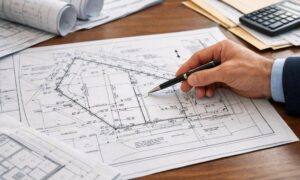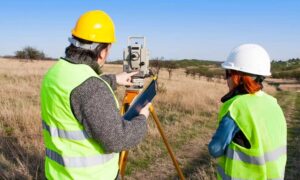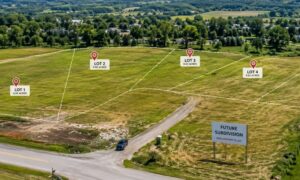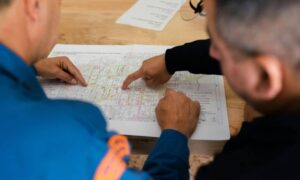
Most property owners receive their plat of survey and go straight to the drawing. They look at the shape of the lot, scan for their property lines, and file the document away. That is understandable. But the drawing is only part of the story. Knowing how to read the full document, not just the picture, gives you far more useful information as a developer or property owner.
This article walks through what a completed plat of survey actually contains, why every section matters, and how to use it well after the project is done.
Why the Notes Section on a Plat of Survey Deserves More Attention
Most people skip the notes. That is a mistake.
The notes section of a plat of survey contains written details that do not fit neatly into the drawing. This includes information about what monuments were found during the survey, what record documents were used to establish the boundaries, and any observations the surveyor noted in the field.
For example, if the surveyor found an existing iron pin that did not match the recorded deed distance, that will often be noted in writing. If there were conflicting records between two deeds, the notes explain how the surveyor resolved them and why.
Reading the notes gives you context. Without them, you are only seeing the outcome. With them, you understand how the surveyor reached those conclusions. That matters if a boundary question comes up later.
What to look for in the notes section:
- Monuments found versus monuments set
- Record documents referenced (deed book and page numbers, plat names)
- Discrepancies between record information and field measurements
- Any limitations on the scope of work performed
What Symbols and Line Types on a Plat of Survey Actually Mean
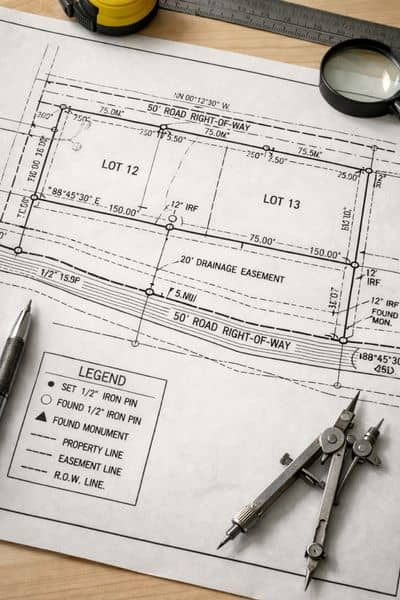
The drawing on a plat of survey uses a specific visual language. Not everyone knows it, but it is not hard to learn.
Line types carry meaning. A solid line usually represents a boundary that was measured and established. A dashed line may represent a line that was calculated from record information but not directly measured in the field. Some surveys use dotted lines for easements or right-of-way limits.
Symbols point to physical objects. A small circle or a square with a dot may represent a found monument, such as an iron rod or pipe. A similar symbol with a different fill might show a monument that was set by the surveyor during the current project.
Labels give measurements. The numbers along boundary lines represent distances, usually in feet. Angles or bearings describe the direction each line runs.
Most survey drawings include a legend. If something is not clear, the legend is the first place to look. If the legend does not explain a marking, contact the surveyor directly. Guessing at what a symbol means can lead to problems when you are planning improvements.
How a Plat of Survey Helps Future Property Improvements Go More Smoothly
A completed plat of survey does not stop being useful the day you receive it.
Years later, when you want to add a fence, build a detached garage, install a pool, or extend a driveway, the survey becomes a planning tool. It shows exactly where the property lines are and gives you a reliable reference for measuring setbacks required by local zoning ordinances.
Without a survey, contractors sometimes estimate where the boundary is. That can lead to fences built over the line, structures too close to easements, or permit applications that do not match actual conditions on the ground.
In Michigan, many local municipalities require a current survey as part of the permit process for certain improvements. Having one on hand speeds up that process. It also reduces the chance of a neighbor dispute when construction begins.
Keep a copy somewhere easy to find. Do not assume you will remember where the lines are just because you watched the surveyor work.
Why Comparing Older Records to a New Plat of Survey Can Reveal Important Differences
Property records change over time, and not always in ways that are obvious.
An older deed may describe the property using measurements that were standard decades ago but have since been found to be slightly off. A previous sketch or survey may have used different equipment or different source records. Encroachments from neighboring properties may have developed over the years.
A new plat of survey reflects what conditions exist now. It is based on current field measurements and updated record research. If the new survey shows something different from an older document, that difference is worth understanding.
Common reasons for differences between old and new surveys include:
- Improved GPS and measurement technology used in recent surveys
- Additional deed research that uncovered conflicting legal descriptions
- Physical changes to monuments in the field
- Corrections to mapping errors in older records
If you notice a significant difference between an older survey and a new one, ask the surveyor to explain it. Understanding the reason helps you make better decisions about the property going forward.
Where to Store and Share a Plat of Survey After the Project Is Finished
A plat of survey is a legal document. Treat it like one.
Digital copies are important. Scan the original and save it in at least two locations, such as a cloud storage folder and a backup hard drive. Name the file clearly so it is easy to find. Use a format like: PropertyAddress_SurveyDate_PlatOfSurvey.pdf.
Who else should have a copy:
- Your title company, if the survey was done as part of a real estate transaction
- Your architect or engineer, if site design work is planned
- Your general contractor, before any site work begins
- A family member or business partner, if the property is jointly held
In Michigan, a licensed surveyor may record certain types of surveys with the county register of deeds. Ask your surveyor whether the completed document was recorded and, if so, request the recording information. A recorded survey is part of the public record and can be accessed later if the original is lost.
Do not assume your surveyor keeps permanent copies. Some firms retain records for years; others do not. Request a copy in digital format at the time of delivery.
Frequently Asked Questions
1. Does a plat of survey show every feature located on my property?
Not necessarily. What appears on the document depends on the type of survey that was performed. A boundary survey focuses on property lines and monuments. A topographic survey adds elevation data and physical features. Always confirm the scope with your surveyor before the work begins so you know what to expect on the finished document.
2. Should I keep my plat of survey after buying or selling a property?
Yes. Even after a sale, survey records can be useful for future improvements, refinancing, title questions, and permit applications. Retain both a physical copy and a digital backup. If you sold the property, keep a copy for your own records in case boundary questions arise related to the time you owned it.
3. Can a plat of survey be used by contractors working on my property?
Yes. Builders, grading contractors, and fence installers often use the survey drawing as a reference when planning their work. Sharing a copy before construction begins helps reduce mistakes related to setbacks, easements, and boundary locations.
4. Why does my new plat of survey look different from an older one?
Differences can result from improved measurement technology, additional record research, physical changes to monuments in the field, or corrections to errors in older documents. If the difference is significant, ask the surveyor to walk you through the reason. Understanding the source of the change helps you rely on the new document with confidence.
5. Can I request additional information to be shown on a plat of survey?
In some cases, yes. The scope of a survey can be adjusted before work begins to include additional features such as easements, utilities, structures, or topographic data. Once the survey is complete, adding information may require additional fieldwork and a revised document. Discuss your needs with the surveyor at the start of the project.