
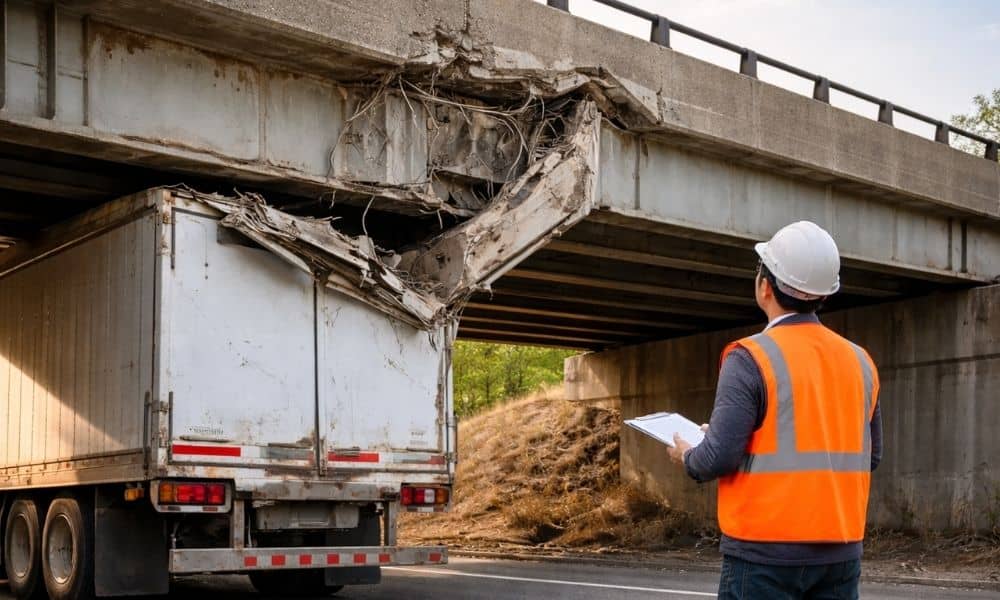
When a major bridge in Michigan suddenly closed after a high-load truck struck it, drivers felt the impact right away. Traffic backed up. Detours started. News crews showed images of bent steel and damaged beams. Many people asked the same question: If the bridge didn’t collapse, why shut it down? The answer is simple. Even when damage looks minor, engineers must perform a structural inspection before allowing traffic back on. Safety always comes first. And when a structure takes a direct hit, no one can rely on guesswork.
However, this situation isn’t just about highways. It offers an important lesson for property owners, business operators, and developers across Grand Rapids.
What Happens When a Structure Takes a Hit
A bridge works like a team. Each beam, girder, and connection shares the load. When one part shifts or bends, the entire system adjusts. Sometimes that adjustment works. Other times, it creates hidden stress.
For example, a truck strike can:
- Bend steel beams
- Crack concrete supports
- Shift bearings that allow movement
- Loosen bolts and welded joints
Even if the damage looks small, the internal force path may change. And once the load path changes, stress spreads to areas that were never designed to carry it.
That’s why engineers never rely on surface appearance alone.
Instead, they order a structural inspection to understand what truly happened inside the system.
Why Authorities Closed the Bridge Immediately
Many people assume officials close bridges only when collapse seems likely. In reality, engineers act much earlier.
First, they assess whether the structure can safely carry traffic. Next, they evaluate whether damage could worsen under continued load. Finally, they consider public risk.
Even a slight misalignment can grow worse with thousands of vehicles crossing each day. Therefore, engineers close access to prevent added stress until they complete a full structural inspection.
This approach protects both drivers and the structure itself.
What Engineers Do During an Emergency Structural Inspection

An emergency structural inspection follows a clear process. It does not rely on guesswork or quick opinions.
First, engineers examine visible damage. They measure deflection, check alignment, and inspect connections. Then, they compare the current condition with original design drawings.
After that, they analyze how the structure now carries load. If one beam no longer supports weight as intended, engineers calculate how the system redistributes stress.
Sometimes the solution involves reinforcement. Other times, crews replace damaged sections entirely. In rare cases, engineers restrict traffic weight until repairs finish.
Throughout the process, documentation plays a key role. Insurance carriers, municipalities, and safety agencies require formal reports before reopening a structure.
Because of this, a structural inspection protects not just safety, but also legal and financial stability.
Why This Matters in Grand Rapids
Although this story centers on a highway bridge, the lesson applies to private property too.
In Grand Rapids, many commercial buildings handle heavy equipment, delivery trucks, and industrial loads every day. Accidents happen more often than people realize.
For instance:
- A forklift strikes a warehouse column.
- A semi-truck hits a loading dock canopy.
- A crane bumps a steel beam during construction.
- A heavy rooftop unit gets installed without checking structural capacity.
At first glance, the damage may seem minor. Paint chips. A small dent. Maybe a visible crack.
However, just like the bridge incident, that impact may alter how the building carries weight.
Without a structural inspection, owners cannot know whether the building remains safe.
The Hidden Risk of “It Looks Fine”
One of the biggest mistakes property owners make involves relying on appearance.
Steel can stretch before it cracks. Concrete can fracture internally before showing surface signs. Connections can weaken while still holding shape.
As a result, a building might operate normally for weeks or months before signs of distress appear.
Meanwhile, loads continue. Equipment runs. Workers move inside. Stress builds quietly.
That’s why engineers treat impact events seriously. Even if everything looks stable, the structure may have shifted in ways that only a structural inspection can reveal.
The Business Side of Structural Inspections
Safety matters most. However, business factors also play a major role.
If a building sustains damage and the owner fails to document it properly, insurance claims may face delays or denials. In addition, city officials may require stamped engineering reports before allowing re-occupancy.
Furthermore, ignoring impact damage can lead to larger repairs later. A weakened beam may cost little to reinforce early. Yet if failure spreads, repair costs can multiply quickly.
Downtime also hurts operations. When authorities closed the Michigan bridge, traffic disruptions started immediately. Businesses felt the ripple effect.
Likewise, when a commercial building closes unexpectedly, tenants, employees, and customers all feel the impact.
Therefore, a timely structural inspection reduces uncertainty and protects long-term stability.
When Should You Request a Structural Inspection?
Property owners should consider a structural inspection after any significant impact event.
Call an engineer if:
- A vehicle strikes a structural column or beam
- Heavy equipment contacts framing
- Cracks appear after a known collision
- Structural elements shift or bend
- Major mechanical equipment gets added without prior review
Early evaluation prevents small issues from becoming major liabilities.
Moreover, documented inspection reports provide peace of mind. They show insurers and city officials that the property owner acted responsibly.
The Bigger Lesson From the Bridge Closure
The sudden bridge closure in Michigan reminds us of one simple truth: structures don’t need to collapse before engineers act.
Impact changes how buildings and bridges behave. Even small events can alter load paths and increase stress in hidden areas.
A structural inspection gives engineers the information they need to make safe decisions. It protects lives. It protects property. And it protects long-term investment.
In Grand Rapids, where commercial and industrial properties carry heavy loads every day, that lesson matters.
Because whether it’s a highway bridge or a private warehouse, structural safety never relies on appearance alone. It relies on informed evaluation.
And that evaluation begins with a structural inspection.
